China configuration reference
- China model reference
- ASD 535A-3 CN
- Monitoring area
- 2,000 m²
- Sampling pipe
- 300 m
- Sampling holes
- 60
- Farthest hole
- 110 m
SecuriSmoke ASD · Product
High-performance single-channel aspirating smoke detector
SecuriSmoke ASD 535-3 is the single-channel configuration for large monitoring areas, long sampling networks and demanding environments such as high-bay storage, deep-freeze warehouses and large data centres.
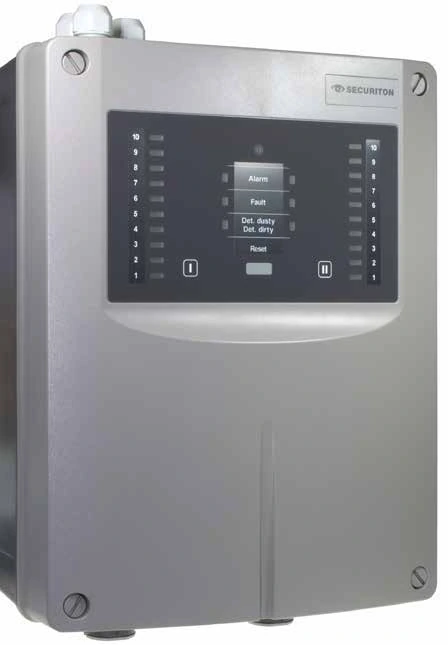
Start with zone structure, pipe complexity, environment, interfaces and destination-market approval—not maximum area alone.
The two data bases below come from different official product materials. Do not combine them into one design.
Usable values depend on the applicable class, topology, hole sizes, pressure, transport time and certificate configuration.
| Alarm sensitivity | 0.02% to 10% obs/m |
|---|---|
| Pre-signal | From 0.002%/m |
| Suction pressure | > 400 Pa |
| Permissible temperature range | -30 °C to +60 °C |
| Protection type / humidity | IP 54 / up to 95% RH, non-condensing |
| Supply voltage | 10.5 to 30 VDC |
| Typical current consumption | 260 to 290 mA at 24 VDC |
| Event memory | 430 events on board |
| Optional event storage | Optional MCM35 storage expansion; capacity depends on the selected configuration |
| Programmable relays | 3 on board (alarm, fault and one free relay) |
| Smoke-level display | 10-level LED |
| PC connection | USB |
| Network | Optional RS-485; no native Ethernet |
| Dimensions | 265 × 348 × 148 mm |
Project rule: published maxima are not construction values. Use the current ASD PipeFlow version and obtain competent destination-market review.
These conditions change sampling performance, transport time and false-alarm control.
A long network must be modelled in ASD PipeFlow with every branch, bend, sampling point and capillary. Verify pressure, transport time, airflow balance and the applicable EN 54-20 class.
Large and high spaces may require sampling at more than one level because smoke stratification can delay roof-level detection. The final arrangement requires a fire-engineering review and functional testing.
The detector operating range is -30 °C to +60 °C. Deep-freeze applications also require condensation control, icing protection, wall-penetration sealing, filtration and accessible maintenance.
Centralised return-air monitoring can dilute smoke. Early quantity rules can only support concept screening and must be checked against the current design method.
A larger model is not automatically the better model. Choose the clearest compliant structure.
ASD 532 is a compact medium-sized single-pipe system; ASD 535-3 is better suited to long networks, higher suction demand and lower temperatures.
Review ASD 532 ↗COMPAREASD 535-4 provides two independent channels for two zones or two separately calculated pipe networks.
Review ASD 535-4 ↗FULL SERIESChannels, pipe capability, sensitivity, environment, applications and limitations.
Open comparison ↗An approval mark does not mean automatic acceptance in every country, configuration or fire system.
Confirm the exact certificate, model suffix, approved configuration, current validity and local authority requirement before quotation or design.
Review certificate previews and scope notes →Public answers support first-stage screening; formal confirmation requires project inputs.
ASD 535-3 has one high-performance detection channel, while ASD 535-4 has two independent channels. Choose by zoning and independent alarm requirements, not by total area alone.
Its operating-temperature range supports evaluation for deep-freeze environments, but the design must also address condensation, icing, filters, wall penetrations, return air and maintenance access.
No. The 300 m figure is a system capability reference. Main pipes, branches, capillaries, sampling holes and transport time must be confirmed by the applicable approval and a project-specific PipeFlow report.
Fact / advice boundary: manufacturer data is presented as fact; model screening and project sequence are PEIEN technical recommendations; final values remain project assumptions until reviewed.
Last reviewed: 30 July 2026 by the PEIEN technical content team. Project-level review must be completed by a suitably qualified fire professional or an ASD practitioner with relevant project experience.